The military capabilities NATO Allies buy today will still be in service in 2060. The ships, aircraft, bases and supply chains being funded under the Alliance’s new 5% defence investment commitment will operate in a climate very different from the one they are being designed for. Getting those investments right is no longer only an environmental question. It is a question of readiness.
That was the starting point for the fifth edition of the Montréal Climate Security Summit, held on 15 and 16 October 2026 under the theme Resilient Defence: Climate-Smart Investments on the Road to 5%. Co-organized by the NATO Climate Change and Security Centre of Excellence (CCASCOE) and the Conference of Defence Associations (CDA) Institute, the Summit brought together around 300 participants, including military leaders, NATO and government officials, diplomats, scientists, industry, civil society, and northern and Indigenous voices for two days of plenary panels, roundtables, workshops and wargames.
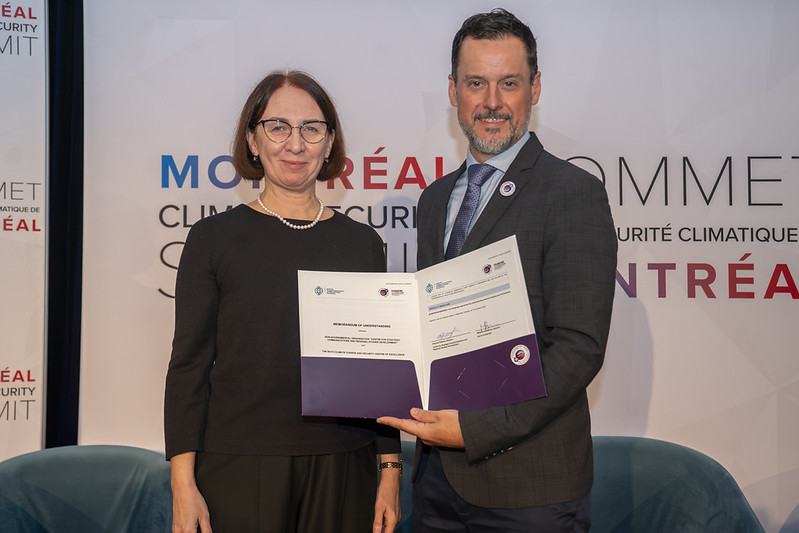
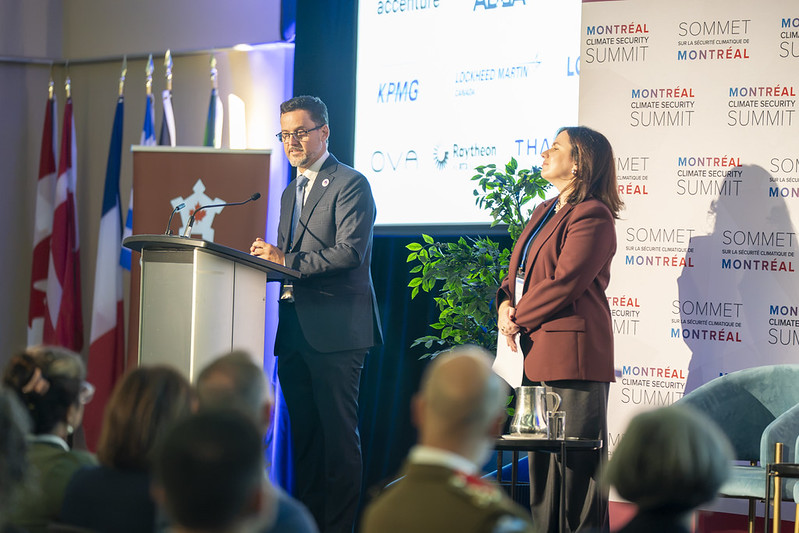
CCASCOE Director Mathieu Bussières and Dr. Gaëlle Rivard Piché, Executive Director of the CDA Institute, opened the Summit.
“Done properly, climate-smart investment is defence money that works harder,” says Bussières. “Climate impacts are increasingly being considered when requirements are defined; capabilities are tested, and codes are being developed. This is because of our efforts. But there is still plenty of room for improvement.”
Day 1: Enabling the investment shift
The first day focused on policy, governance and the industrial ecosystems that will turn spending commitments into real capability.
The opening plenary, The State of Climate Security in Defence Investment Planning, set the strategic context. Her Excellency Hanne Ulrichsen, Ambassador of Norway to Canada, Brigadier Tim Symonds OBE of the British Army, Dr. Kirsty Lewis of the UK Met Office, Gregory W. Ivey, Director of Armaments and Major Capability Programmes at NATO, and Swathi Veeravalli of Georgetown University examined how climate risk and strategic competition are reshaping defence priorities.
Ambassador Ulrichsen followed with a keynote offering a Norwegian perspective on governing climate-smart defence investment across the Alliance.
The second plenary turned to industry. Under the title Climate-Smart Defence Industry: Scaling Capacity and Innovation Across the Alliance, Rafal Rybacki of the European Investment Bank, Dr. Matko Barišić of NATO DIANA, former Nunavut Premier P.J. Akeeagok of Arctic Strategies Inc., Marc Caroll Dupuis of Arctech Accelerate and Dr. Louise van Schaik of the Clingendael Institute discussed how finance, innovation and northern partnerships can help the defence industrial base scale up while becoming more resilient.
In the afternoon, participants moved into breakout sessions designed and led by partner organizations:
- Built Once, Used Twice: the industrial case for cross-domain investment, led by Loom Strategy Centre
- From Awareness to Action: embedding climate resilience in defence investment and procurement, led by the European Commission’s DG CLIMA and the European External Action Service, with Ambassador Anthony Agotha, EU Special Envoy for Climate and Energy Security
- What Counts?: identifying climate-smart security investments for NATO’s 5% framework, a two-part workshop led by the International Military Council on Climate and Security with Sherri Goodman, Caroline Baxter and the Hon. John Conger
- Setting the Standards for Climate Security: data-driven and interoperable analysis, a two-part session led by UK Dstl, the UK Met Office and CCASCOE
- Critical Minerals, Critical Partnerships: aligning security, industrial development and the energy transition, led by E3G
- Operational Energy as Operational Advantage: climate-smart defence investments in practice, led by BwConsulting, the in-house consultancy of the German Armed Forces
Day 2: Investing in future forces
The second day shifted from frameworks to people, capabilities, and delivery.
Major-General Nicolas Pilon, Chief of Staff – Infrastructure and Environment of the Canadian Armed Forces, opened the day with a keynote address on designing climate-smart forces through people, platforms, and preparedness. The plenary that followed, Building Operational and Human Readiness under Climate Stress: Which Investment Priorities?, brought together Paul Rushton of NATO Headquarters, Caroline Baxter of the Council on Strategic Risks, Controller General Frédéric Tournay of France’s Directorate General for Civil Security and Crisis Management, Élise Godin of the Department of National Defence, José Antonio Coll of Airbus Defence and Space and Iris Ferguson of IAF Strategies. Their discussion connected personnel health and readiness with the infrastructure, equipment and civil-military cooperation they needed.
The day’s breakout sessions explored some of the sharpest edges of the climate-security agenda:
- Low-Carbon Pathways on the Road to 5%: led by the Conflict and Environment Observatory and the Initiative on GHG Accounting of War
- Facing Megafires: capability and doctrinal challenges for the defence community, led by the French Joint Defence Staff
- The Readiness Dividend: red-teaming and citizen-based volunteer civil protection as a climate-smart investment, led by Defence Research and Development Canada and Civil Protection Youth Canada
- Maintaining Durability: Arctic maritime security infrastructure in increasingly uncertain environments, led by the Harvard Arctic Initiative and Converge Strategies
- Resilient Energy Systems for Defence and Civil Security: climate-proofing power generation and distribution, led by Institut AdapT of the École de technologie supérieure
- Climate Security in the Context of Hybrid Threat: Ukraine’s experience of information resilience and risk communication, led by the Center for Strategic Communications and Regional Studies Development
- Wargaming, Climate Security and Climate Adaptation: an interactive workshop led by Archipelago of Design and The Adaptation Game
Yassira Benabed, Training Officer in CCASCOE’s Education and Training Branch, and Pauline Baudu, Programme Director for Resilience and Sustainable Defence at the CDA Institute, drew the threads together in recap sessions at the end of each day.
The Summit closed with a keynote by Dr. Marie-Pierre Ippersiel, President and CEO of PRIMA Québec, on Delivering Climate-Smart Capabilities Through Partnerships and Innovation, followed by closing remarks from Mathieu Bussières and Dr. Gaëlle Rivard Piché.
“The Summit is shifting discussions towards costs, materials, timelines, and trade-offs. We have stopped asking the question of whether climate change belongs in defence and we’re moving on to the questions of how we can implement solutions, which for me is a very important step,” says Bussières.
What carries forward
Across two days, one idea kept coming back: climate resilience is not a cost added on top of defence investment. It is part of what makes that investment last. Decisions taken now on procurement, infrastructure, energy and people will shape how well Allied forces can operate for decades.
For CCASCOE, the Summit is also a meeting point for a growing community. The relationships built in Montréal, between militaries and scientists, governments and industry, and northern communities and Allied partners, are where many of the Centre’s future projects, research and training activities begin.
Explore highlights from the 5th Montréal Climate Security Summit through our photos and recordings. A report capturing key insights and takeaways will follow.
Thank you
CCASCOE thanks the CDA Institute for another year of close partnership, all speakers, moderators and session leads, and every participant who contributed to the discussions.
Special thanks to the Department of National Defence’s Mobilizing Insights in Defence and Security (MINDS) program for its support, to Airbus as Lunch Sponsor and Archipelago of Design as Reception Sponsor, and to exhibitors Frazer-Nash Consultancy, Planet Labs and Volt-Age Concordia.
We look forward to the next edition.