Join Our Newsletter
Stay up to date with news and updates from CCASCOE, right in your inbox!
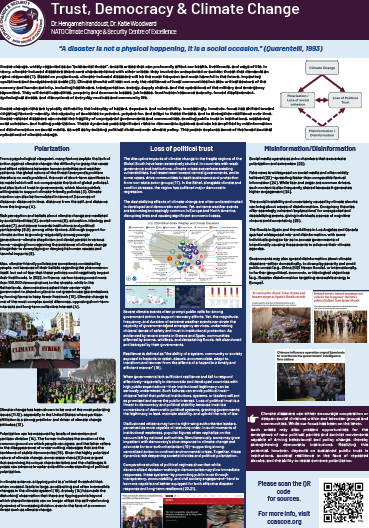
The poster was presented at the European Congress of Psychology 2025 as part of the Psychology and the governance of society track.
Sources
- [1] IPCC, 2023: Climate Change 2023: Synthesis Report. Contribution of Working Groups I, II and III to the Sixth Assessment Report of the Intergovernmental Panel on Climate Change [Core Writing Team, H. Lee and J. Romero (eds.)]. IPCC, Geneva, Switzerland, 1-34.
- [2] Quarentelli, E. (1993) Technological and Natural Disasters and Ecological Problems: Similarities and Differences in Planning For and Managing Them.
- [3] Smith, E. K” and Mayer, A. (2018) A social trap for the climate? Collective action, trust and climate change risk perception in 35 countries. Global Environmental Change, Volume 49, p. 140-153.
- [4] Van Lange, P.A.M. and Rand, D.G. (2022) Human Cooperation and the Crises of Climate Change, COVID-19,and Misinformation, Annu. Rev. Psychol. 73:379–402.
- [5] Pearson, A.R. et al (2016) Social Climate Science: A New Vista for Psychological Science, Perspectives on Psychological Science, 11(5).
- [6] Cole, J.C., Ehret, P. J., Sherman, D. K., & Van Boven, L. (2022) Social norms explain prioritization of climate policy. Climatic Change, 173(1-2), 10.
- [7] Steg, L. (2023) Psychology of climate change. Annual Review of Psychology, 74, 391-421.
- [8] Cole, J. C., Gillis, A. J., van der Linden, S., Cohen, M.A., & Vandenbergh, M. P. (2023) Social psychological perspectives on political polarization: Insights and implications for climate change. Perspectives on Psychological Science.
- [9] Leiserowitz, A., et al. (2023) Climate Change in the American Mind: Beliefs & Attitudes, Spring 2023. Yale University and George Mason University. New Haven, CT: Yale Program on Climate Change Communication.
- [10] Gordon, G. and Press, B. (2023) Climate protests: Tracking growing unrest, Carnegie Endowment for International Peace.
- [11] APA Climate Change Task Force. (2022) Addressing the climate crisis: An action plan for psychologists. https://www.apa.org/news/press/releases/2022/02/climatecrisis-action-plan.pdf
- [12] Pew Research Center. (2020) As economic concerns recede, environmental protection rises on the public’s policy agenda. SELL Journal, 5.
- [13] Tesler, M. (2018). Elite domination of public doubts about climate change (not evolution). Political Communication, 35(2), 306–326.
- [14] Macy, M.W. et al. (2021) Polarization and tipping points, PNAS 2021 Vol. 118 No. 50.
- [15] Dahl, R. (1967) Pluralist Democracy in the United States, Rand McNally, Chicago, IL.
- [16] Lenton, T., Rockström, J., Gaffney, O., Rahmstorf, S., Richardson, K., Steffen, W., Schellnhuber, H. (2019) Climate tipping points – too risky to bet against, Nature. 575 (7784): 592–595.
- [17] de Coning, C., et al. (2022). Security Risks of Environmental Crises: Environment of Peace (Part 2). Stockholm International Peace Research Institute. https://doi.org/10.55163/VZIQ7863
- [18] United Nations Office for Disaster Risk Reduction. 2023. Resilience. https://www.undrr.org/terminology/resilience.
- [19] Alesina, A., and Giuliano, P. (2015) Culture and Institutions, Journal of Economic Literature 53,4: 898–944.
- [20] Kaim, A. & Kubbe, I. (2025) Risk, Hazards & Crisis in Public Policy, Wiley.
- [21] Bruun, O. (2025) Eco-authoritarianism: new debates and changing premises, Political Science and Public Policy 2025, https://doi.org/10.4337/9781802208955.00024
- [22] Atari, M., et al. (2022). Morally homogeneous networks and radicalism. Social Psychological and Personality Science, 13(6), 999–1009.
- [23] Pennycook G and Rand DG. (2021) The psychology of fake news. Trends Cogn. Sci. 25(5):388–402.
- [24] Vosoughi, S., Roy, D., Aral, S. (2018) The spread of true and false news online. Science 359(6380):1146–51.
- [25] Jedinger, A. and Masch, L. (2025) Need for cognitive closure, political trust, and belief in conspiracy theories during the COVID-19 pandemic. Front. Soc. Psychol. 2:1447313. doi: 10.3389/frsps.2024.1447313
- Information
This publication is a product of the NATO Climate Change and Security Centre of Excellence (NATO CCASCOE). It does not necessarily reflect the policy, view, opinion of the NATO CCASCOE, NATO or any government. The NATO CCASCOE may not be held responsible for any loss or harm arising from the use of information contained in this publication and is not responsible for the content of the external sources, including external websites referenced in this publication.